
London Bridge (London, England)

Picture by unknown

Niagra Falls (United States and Canada)

http://stefanobittante.blogspot.com/2007/06/niagara-falls-panorama.html

Eiffel Towel (Paris, France)

Picture by unknown

Kyoto (Japan)

Picture by unknown

Showing posts with label EUROPE. Show all posts

Sunday, April 21, 2013

Paris Top Tourist Attractions

 
FRANCE
There are a multitude of tourist attractions in Paris for visitors. The richness of culture in France gives you so many choices of things to do in France and have fun learning about. 


Eiffel Tower

One of the world's most recognizable monuments and the best known landmark in Europe, the Eiffel Tower is the symbol of Paris and one of the city's must-see attractions. Be sure to take the lift for a view of the city. 

Arc de Triomphe

The Arc de Triomphe, located at the Place Charles de Gaulle commemorates Emperor Napoleon's victories. It is a huge triumphal arch that was commissioned by Napoleon in 1806 and competed in 1836, long after Napoleon's reign had come to an end.  Visitors to Paris can enjoy a wonderful view of the city of Paris from the top of this very famous landmark. If you visit the Arc in the evening hours, you will be rewarded with a panoramic view of the lights of Paris.

Notre Dame

Notre Dame Cathedral, located on Ile de la Cite in central Paris, is a top Paris landmark and one of the most famous churches in the world, which is one of the first Gothic cathedrals ever built. Construction started in 1163 and lasted for almost two decades.

Notre Dame Cathedral's dramatic towers, spire, stained glass and statuary are guaranteed to take your breath away. Witness firsthand the spot that was once the heartbeat of medieval Paris, and that took over 100 years of hard labor to complete. From the lookout at the north tower you have a great view over the city.

Although admission to the cathedral is free of charge, there is a fee to visit the treasury and the church tower.

Sacre Coeur Paris

With its unmistakeable white dome, the Sacre Coeur sits at the highest point of Paris on the Montmartre hill, or butte. This basilica, which was consecrated in 1909, is best-known for its garish gold mosaic interiors and for its dramatic terrace, from which you can expect sweeping views of Paris on a clear day.

Sainte Chapelle

Sainte Chapelle was built in 1248 by King Louis IX at the Île de la Cité to store important religious relics. The Sainte-Chapelle is best known for the soaring stained glass windows that line the upper chapel. This chapel is a marvel of perfect medieval stained glass that turns the sun's light into a symphony of color.

Sainte Chapelle is very popular so expect to wait in line. Lines are shortest within the first hour of opening. On weekdays the chapel closes from about 1:00 until 2:15. If you arrive shortly before then, the number of visitors diminishes as you approach the closing time, giving you better visibility, but less time to spend.

Champs-Elysées

The Avenue des Champs-Elysées is the most prestigious and most famous street in Paris and possible in the whole world. It stretches all the way from the Place de la Concorde to the Arc de Triomphe.
 
Panthéon

The Panthéon, a 19th century building, was originally built as a church dedicated to St.Genevieve (the patron saint of Paris), but later turned into a civil temple. The Pantheon building itself represents a fine example of neoclassicism.
 
Disney Land Paris

Disneyland Paris is very similar to the Disneyland theme parks located in Anaheim and Orlando. Visitors to Paris with children can enjoy an excursion to Disneyland during their Paris vacation.

Musée du Louvre

One of the not-to-miss sights in Paris is the Louvre Museum, possibly the most famous museum in the world with a fabulous collection of pre-20th century painting, sculpture, and decorative objects.  Arguably the world's most famous art museum, the Louvre's most popular piece is Leonardo da Vinci's "Mona Lisa." It is housed in the Louvre Palace, once the residence of France's royal family.

The Mona Lisa can be found on the second floor (i.e. 1er Etage) of the Denon Wing of the Louvre Museum

Musée d'Orsay
 
The Musée d'Orsay is a museum housed in a grand railway station built in 1900. Musée d'Orsay picks up where the Louvre leaves off, featuring French art from the mid 1800s to the 1st World War. Home to many sculptures and impressionist paintings, it has become one of Paris's most popular museums.

Seine River

The Seine is a major river of North Western France and one of its well-known commercial waterways.

Centre Pompidou

Centre Pompidou is a cultural center in the heart of historic Paris. The complex was built in 1977 by Renzo Piano and Richard Rogers. It includes a museum of modern art and a large library.

Pompidou is a giant, futuristic arts centre located in the Beaubourg district of Paris.


Sunday, December 23, 2012

France - Traditional French Foods


FRANCE
French cuisine is popular for its delicious, diversified and world-wide known cuisine. Traditional French foods range from delectable cheeses and desserts to hearty soups, stews, and fresh fish. One of the great things about French traditional food is the fact that each region has its own specialties that are traditional and unique to that area. These French traditional food items are based off the available items within that particular region. In this writing, we only give you some general ideas of the most popular traditional French foods. Look for the regional favorites while visiting France if you want to taste the best of the region.

Escargot

Escargot (Photo: myboringoldlife blog)
Most people unfamiliar with French cooking are quick to turn up their collective noses at this dish.  Perhaps the most widely know of the traditional French dishes, escargot is a delicacy made from snails.  Served as an appetizer, escargot is usually prepared in a garlic butter sauce.  The snails themselves are first removed from the shell, cleaned, and then placed back inside the snail shell after preparation.  Escargot generally come served with an herb butter sauce for dipping.  This traditional French dish even has its own utensil; escargot comes to the table with special tongs designed for holding the shell.

Bouillabaisse

Bouillabaisse from the Restaurant du Port, Le Grau du Roi, Marseille
Bouillabaisse is a French fish soup that is a specialty of the region of Provence and is one of the most familiar of the traditional French dishes. Three kinds of fish usually go into this traditional French dish, including scorpion fish, conger and monkfish.  Cooked with special herbs like saffron and garlic, as well as orange zest, bay leaf, and fennel.  Leeks, tomatoes, celery, and onions simmer together with the fish and spices.  Bouillabaisse is served with crusty French bread topped by rouille, a mayonnaise made with olive oil, cayenne, garlic and saffron.

Pumpkin Soup

Soupe au potiron (Photo: Cityfoodsters)
In the center of France, soupe au potiron is a favorite. In the fall, when pumpkins and potatos are harvested, this soup is featured on many traditional tables. The main ingredients are mixed with cream and topped with croutons or served with a freshly-baked baguette.

Chestnut Soup

Soupe aux chataignes (Photo: dandyman blog)
Another seasonal favorite is soupe aux chataignes. Locally-grown chestnuts are mixed with potatos, leeks, and turnips to make a hearty, and yet sweet, winter soup. While this French soup is more difficult to make because finding fresh chestnuts and peeling them can be tricky, it is a great recipe to try for a special occasion.

Coq au Vin

Coq au Vin (DB Bistro Moderne)
Literally “chicken and wine”, this dish is a combination of braised  rooster served in a special wine sauce.  Coq au vin, like many traditional French dishes, varies slightly by region.  Wine sauce preparation depends upon the area, though a burgundy is the most common choice.  After the chicken marinates in the wine one day before, it is seared in a hot pan.  Small mushrooms, onions, garlic, butter and salt pork (bacon) are added to the chicken and allowed to simmer.  As the sauce thickens, salt, pepper, thyme and other savory herbs are added to the pot.

Cassoulet

Cassoulet (Photo: Xoom Blog)
A traditional southwestern bean recipe, cassoulet is a perfect winter meal. It has lots of meat in it, but the meat is cut up into the bean dish and simmered. While this taste is not for everyone, it's a truly traditional meal hailing from France. Serve with bread on the side.

Moules

Moules frites (Photo by N. Galuten)
Mussels are a common seafood served in France. Most often cooked in garlic, the mussels take on a spicy flavor; paired with French fries in most restaurants, this dish is a favorite of French cuisine in many countries of Europe.

Tartiflette

Tartiflette (Photo: Ricado Cuisine)
Tartiflette is a French dish from the Haute Savoie region of France. It is made with potatoes, reblochon cheese, lardons and onions. A popular variation of this dish is to substitute the lardons with smoked salmon. While this dish features potatos and cheese, it is rich enough to become a main course on most tables. A traditional meal in the Alps, this dish is heavy and warms the body from the inside-out with its soft potatoes layered in creamy melted cheese.

Bouillinade

Bouillinade de poissons (Photo: moicatalane)
Potatoes and fish baked together with butter and herbs makes for a fresh potato alternative. Typically southern, the herbs mixed here (saffron, parsley, cayenne) are a new combination for many non-Mediterranean palates. 

Crèpes

Crèpes (G. Paul Burnett/The New York Times)
A standout favorite among traditional French dishes, crèpes can be served either as a dessert or a savory dish.  Crèpes are made from a very thin batter of eggs, flour and milk.  The crèpe is allowed to cook in a skillet for about a minute, flipped to cook for another minute, and then removed.  The result is a paper thin shell that can be stuffed with fruits and cream.  Some recipes call for a potato batter and are generally served with savory fillings.


Wednesday, December 12, 2012

Greece Popular Drinks

GREECE

As Greek food is integral to the lifestyle and culture of Greece, Greek drinks have also played a large role in Greek life since the times of Ancient Greece.


Frappé coffee

Frappé coffee
(also Greek frappé or Café frappé) is a Greek foam-covered iced coffee drink made from instant coffee (generally, spray-dried). It is among the most popular drinks in Greece, especially during the summer, and has been called the national coffee of Greece.

The coffee can be made either with a cocktail shaker or an appropriate mixer (e.g. a hand mixer). One or two teaspoons of coffee, sugar (to taste) and a little water are blended to form a foam, which is poured into a tall glass. To this is added cold water and ice cubes, and, optionally, milk - typically evaporated milk. In cafés, frappés tend to be relatively strong and heavy. As they drink, Greeks often top up their frappé with water thus lightening it and extending their drinking time.

Greek Coffee

The most popular Greek drink is the Greek Coffee. Originally Turkish, Greek coffee is loved by all Greeks and is now the national drink. It is a thick beverage, made by boiling finely ground coffee beans, and is served thick and strong, and often sweetened. It is always unfiltered, with the coffee sediment at the bottom of the cup. It is not served with milk but is usually served with a glass of cold water to freshen the mouth to better taste the coffee.

Metaxa

Metaxa is a famous Greek brand of sweet brandy. It is a blend of brandy, spices, and wine, with wine not being present in some of the more expensive editions of the product to allow for a drier taste.

Metaxa comes in six major types: Three Stars, Five Stars, Seven Stars, Twelve Stars Grand Olympian Reserve, Twelve Stars and the Private Reserve. The number of stars represents the number of years the blend has aged in cask, thus the Seven star is the most aged and selected type. The main difference between the Three Stars and the Five Stars is that the latter is noticeably drier, making the alcohol more pronounced. The Seven Stars and the Twelve Stars are more flavoursome and complex. In Twelve Stars the taste of the barrel in which the brandy matured is very noticeable. 

Metaxa is traditionally served neat, on the rocks (ice cube), with tonic or mixed (usually with sours). It is also used as a basic ingredient in several cocktails such as Alexander or the "Greek Mojito".

Retsina

Retsina is the wine with the biggest name recognition in Greece. It has been something like the national beverage for Greeks since the 1960′s. Retsina is either white or rose wine with a strong, distinctive resin taste that can take some time getting used to. Traditionally, back in ancient times, the wine barrels were sealed with Aleppo Pine resin which gave its unique district flavor to the contents. Today the taste is artificially manufactured, and Retsina is an Athens region specialty. It should not be aged. The most well-known and cheap-n-dirty is "Kourtaki Retsina". Some people say Retsina has a flavor as sappy turpentine like, while others (mostly non-Greeks) say that Retsina is definitely an acquired taste.

Retsina should be served cold and is ideal as an accompaniment for all types of Greek cuisine. Like most Greek beverages, it is undeniably at its best when combined with Greek foods, especially the savory mezedes served as appetizers.

Tuesday, December 4, 2012

Greece - Popular Greek Foods


GREECE
There is no denying that when it comes to being passionate about food, the Greeks are some of the best. Greek cuisine is renowned for being flavorsome and fresh, incorporating a wide range of spices, meats and vegetables. The food in Greece is about tantalizing your taste buds and wherever you go you cannot help but be surrounded by the amazing smells of food being prepared and cooked and it really adds to your eating experience. In Greece, you certainly come across a whole wealth of spectacular dishes. If you're looking for some delicious Greek food to try, here's a selection of the popular local dishes for you to try next time you are in the country, in addition to Greece national dishes. A trip to Greece is guaranteed to not only have you in awe of the history and culture and people, but also in terms of the exquisite food you will be introduced to.

Gyros

Gyro (photo)
Gyros is the popular traditional Greek fast foods. It is a dish of meat (pork or chicken and rarely beef) roasted on a vertical turning spit and served with sauce (often tzatziki) and garnishes (tomato, onions) on grilled pita bread.

To make gyros, pieces of meat are placed on a tall vertical spit, which turns in front of a source of heat, usually an electric broiler. If the meat is not fatty enough, strips of fat are added so that the roasting meat remains always moist and crisp. The rate of roasting can be adjusted by varying the strength of the heat and the distance between the heat and the meat, allowing the cook to adjust to varying rates of consumption. The outside of the meat is sliced vertically in thin, crisp shavings when done. It is generally served in an oiled, lightly grilled piece of pita, rolled up with various salads and sauces. The pita and gyro meat themselves are the only obligatory ingredients.

Fakes
Fakes - Greek Lentil Soup [photo]
Fake is a lentil soup and one of the famous everyday Greek soups, usually served with vinegar and olives and/or smoked herring. It refers to a variety of vegetarian and meat soups made with lentils. The soup may consist of green, brown, red, yellow or black lentils, with or without the husk. Dehulled yellow and red lentils disintegrate in cooking, making a thick soup. Lentil soup may include vegetables such as carrots, potatoes, celery, parsley, and onion. Common flavorings are garlic, bay leaf, cumin, olive oil, and vinegar. It is sometimes garnished with croutons or chopped herbs or butter, olive oil, cream or yogurt.

Souvlaki
Souvlakia
Souvlaki (plural souvlakia) is a popular Greek fast food consisting of small pieces of meat and sometimes vegetables grilled on a skewer. Most common is pork, sometimes lamb or chicken, often marinated in oil, salt, pepper, oregano and lemon. It may be served on the skewer for eating out of hand, in a pita sandwich with garnishes and sauces, or on a dinner plate, often with fried potatoes. The meat usually used in Greece is pork, although chicken and lamb may also be used. In other countries and for tourists, souvlaki may be made with meats such as lamb, beef, chicken and sometimes shrimp or fish (especially swordfish).

Tzatziki
Tzatziki (photo)
Tzatziki is a Greek and Turkish meze or appetizer, also used as a sauce for souvlaki and gyros. It is made of strained yogurt (usually from sheep or goat milk) mixed with finely chopped cucumbers, garlic, salt, olive oil, and sometimes lemon juice, and dill or mint or parsley. Tzatziki is always served cold and with warm pita bread. While in Greece the dish is usually served as an accompaniment, in other places tzatziki is often served with bread (loaf or pita) as part of the first course of a meal.

Skordhalia
Skordhalia (photo)
Skordhalia or skordhalia/skorthalia is made by combining crushed garlic with a bulky base—which may be a mashed potato, walnuts, almonds, or liquid-soaked stale bread—and then beating in olive oil to make a smooth emulsion. Vinegar is often added. It is a thick garlic mashed potato dip (sauce or spread, etc.) which is usually served with deep fried salted fish/cod (bakaliaros skordalia, i.e. fried battered cod with garlic dip, a very popular dish). Skordhalia is also served with fried vegetables (eggplant, zucchini), poached fish, or boiled vegetables (beets). It is sometimes used as a dip.

Pastitsio
Pastitsio (photo)
Pastitsio, sometimes spelled Pastichio, is a Greek baked pasta dish with a filling of ground beef and béchamel sauce in its best-known form. The typical Greek version has a bottom layer that is bucatini or other tubular pasta, with cheese and egg as a binder; a middle layer of ground beef, veal or lamb with tomato and cinnamon, nutmeg or allspice; another layer of pasta; and a top layer of sauce, varying from an egg-based custard to a flour-based Béchamel or a Béchamel with cheese (known as Mornay sauce in France). Grated cheese is often sprinkled on top. Pastitso is a common dish, and is often served as a main course, with a salad.

Stifado

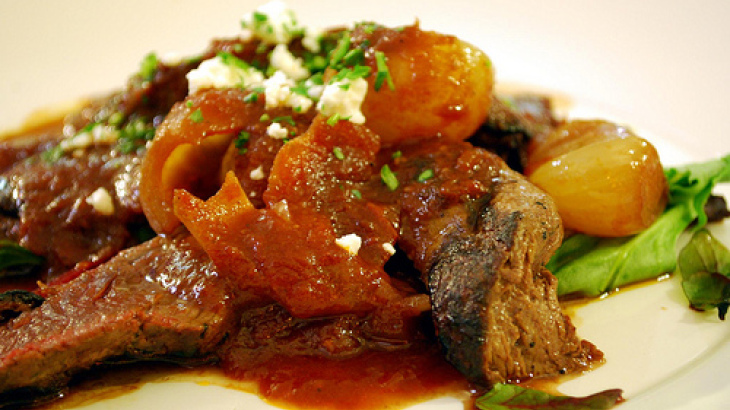
Lamb Stifado (photo)
Greek Stifado dishes are stews with pearl onions, red wine and cinnamon. They are easy to recognize since they include a lot of onions. The most commonly used are whole small boiler or pearl onions, but larger onions can be used as well, and the quantity is often equal in weight to the main ingredient. Stifatho dishes can be made with meat, poultry, seafood, game (rabbit, venison, etc.), or another vegetable as the central ingredient, with onions, wine or vinegar, tomato, and a selection of spices (often including cinnamon) creating a flavorful base. Generally made on the stovetop, there are a few stifatho variations that can be made in the oven.

Spetzofai
Spetzofai (photo)
Spetzofai (or spetsofai) is one of the most classic dishes in Greece. Spetzofai is a braised sausage with pepper and tomatoes. It is a hearty dish originally from the Mt. Pelion region and, of course, a specialty of the mainland area around Mt. Pelion and Volos.

Grilled octopus
Grilled octopus (photo)
The octopus (octopus vulgaris) will be on the menu of every seafood tavern in Greece and practically every Greek restaurant outside of Greece. Greeks enjoy octopus in a stew, with pasta, made into a salad with olive oil and wine vinegar but the most often ordered octopus is the grilled octopus. You should try Octapodaki tou Yiorgou (grilled octopus with lemon, oregano and olive oil).

Achinosalata
Achinosalata (photo)
Traditionally, in Greece, the sea-urchin is eaten freshly opened with just a squeeze of lemon. Achinosalata is sea-urchin eggs in lemon and olive oil.

Mezedes or meze
Mezédhes (photo)
In Greecemezé, mezés, or mezédhes (plural) are small dishes, hot or cold, spicy or savory. Seafood dishes such as grilled octopus may be included, along with various salads, sliced hard-boiled eggs, garlic-bread, kalamata olives, fava beans, fried vegetables, melitzanosalata (eggplant salad), taramosalata, fried or grilled cheeses called saganaki, and various fresh Greek sheep, goat or cow cheeses (feta, kasseri, kefalotyri, graviera, anthotyros, manouri, metsovone and mizithra). Other offerings are fried sausages, usually pork and often flavored with orange peel, bekrí-mezé (the "drunkard's mezé", a diced pork stew), and meatballs like keftédes and soutzoukákia smyrnéika.
In Greece, meze is served in restaurants called mezedopoleíon and tsipourádiko or ouzerí, a type of café that serves ouzo or tsipouro.

Tiropita (Tyropita)
Tiropita (photo)
Tiropita is a Greek layered pastry food, made with layers of buttered phyllo and filled with a cheese-egg mixture. Regular tiropita fillings usually consist of feta cheese, egg, butter and yogurt. However, "kasseropita" contains kasseri instead of feta cheese and, unlike regular tiropita, does not contain yogurt. Tiropita can also be made in a large pan and cut into individual portions after baking. The individual form is sold in bakeries throughout Greece, where it is a popular breakfast and snack food. Alternatives to tiropita are spanakopita, a pie with spinach, as well as bougatsa. In Greece, one can find many varieties of Tyropita:
  • Kourou: Surrounded by a thick pastry.
  • Sfoliata: Surrounded by puff-pastry.
  • Xoriatiki: Made in a Tapsi pan.
  • Tyropitakia: Bite-sized.
  • Skopelitiki: Made in the shape of a twirl.
Tiropita is usually eaten mid-morning by Greeks, who are not accustomed to having "breakfast" in the traditional western-European sense. Specifically, shortly after awakening and before going to work, Greeks typically consume coffee (either Turkish or cold, i.e., frappe) accompanied by cold water and, on occasion, bread with butter and honey. Approximately one to two hours later (mid-morning), tyropita (more commonly) or spanakopita are consumed.

Spanakopita
Spanakopita (photo)
Spanakopita is a Greek savory pastry with a filling of chopped spinach, feta cheese (sometimes in combination with ricotta cheese, as it is less expensive, and adds creaminess), onions or scallions, egg, and seasoning. The filling is wrapped or layered in phyllo (filo) pastry with butter and/or olive oil, either in a large pan from which individual servings are cut, or rolled into individual triangular servings. Spanakopita is mostly eaten as a snack in Greece, and it can be an alternative to tyropita.

Bougatsa
Bougatsa (photo)
Bougatsa is a Greek breakfast pastry consisting of semolina custard, cheese, or minced meat filling between layers of phyllo. Greek bougatsa is prepared from phyllo dough wrapped around a filling. After it is baked, it is cut into serving pieces and served hot. If the filling is semolina custard, then the pastry may be lightly dusted with powdered sugar or cinnamon. All are delicious and popular among Greeks for quick breakfast eats.

Baklava
Baklava (photo)
Baklava is a rich, sweet pastry made of tissue-thin layers of filo pastry filled with chopped nuts and drenched in syrup or honey.

Galaktoboureko
Galaktoboureko (photo)
Galaktoboureko is a Greek dessert of semolina-based custard (sometimes flavored with lemon, orange, or rose) in between layers of phyllo. It may be made in a pan, with phyllo layered on top and underneath, or rolled into individual servings (often approximately 10 cm long). It is served or coated with a clear, sweet syrup.

Greek Yoghurt
Greek Yoghurt with honey (photo)
Greek yoghurtStrained yoghurt or yoghurt cheese is yoghurt which has been strained in a cloth or paper bag or filter to remove the whey, giving a consistency between that of yoghurt and cheese, while preserving yoghurt's distinctive sour taste. Most strained Greek yogurts have no added fats and are made of real milk.

Strained yoghurt is used in Greek food mostly as the base for tzatziki dip and as a dessert, with honey, sour cherry syrup, or spoon sweets often served on top. A few savoury Greek dishes use strained yoghurt. In Greece, strained yoghurt, like yoghurt in general, is traditionally made from sheep's milk. More recently, cow's milk is often used, especially in industrial production. Another Greece must-try food is definitely a yogurt with honey.


Text source [1]

Friday, November 30, 2012

Greece National Foods


GREECE
Food is always a exiting part of a vacation and this is especially true when you get to a new country. You can always tell a lot about the people and the lifestyle of a country by seeing how they eat. The Greek lifestyle is reflected most in the food they eat and when and how they eat. In Greece you will find great variations both when it comes to meat dishes and to fish dishes. In this writing, I give you a list of Greece national foods. You should at least try these dishes to generate a wider understanding of the lifestyle and culture of Greece.

Fasolada
Fasolada
Fasolada, fasoulada or sometimes Fasolia (sometimes written fassolada or fassoulada) is a soup of dry white beans, olive oil, and vegetables, sometimes called the "national food of the Greeks". Fasolada is made by simmering beans with tomatoes and other vegetables such as carrots, onion, parsley, celery, and bay leaf. Lima beans are sometimes used instead of white beans. It is often enriched with olive oil either in the kitchen or on the table. Greek Fasolada does not contain meat. 

Moussaka
Moussaka
Moussaka is an aubergine (eggplant) or potato based dish popular in Balkan cuisine and Mediterranean cuisine. The Greek version includes 3 layers of meat (precooked with spices, herbs, onions, garlic, tomatoes), aubergine (sautéed in olive oil) and topped with a white sauce/Béchamel sauce then baked.

There are variations on this basic recipe, sometimes with no sauce, sometimes with other vegetables. The most common variant in Greece may include courgette (zucchini), part-fried potatoes or sautéed mushrooms in addition to the aubergine.

Feta cheese
Greek Feta Cheese
Feta is a soft white brined curd cheese with small holes traditionally made in Greece. It is a crumbly aged cheese, commonly produced in blocks, and has a slightly grainy texture. Its flavor is tangy and salty, ranging from mild to sharp.

Feta is used as a table cheese, as well as in salads, pastries and in baking, notably in the popular phyllo-based dishes spanakopita ("spinach pie") and tyropita ("cheese pie") and combined with olive oil and vegetables. It can also be served cooked or grilled, as part of a sandwich or as a salty alternative to other cheeses in a variety of dishes.

Saganaki
Saganaki
Saganaki refers to various Greek dishes prepared in a small frying pan. Saganaki is best-known as an appetizer of fried cheese. The cheese used in cheese saganaki is usually kefalograviera, kasseri, kefalotyri, or sheep's milk feta cheese. Regional variations include the use of formaella cheese in Arachova and halloumi cheese in Cyprus. The cheese is melted in a small frying pan until it is bubbling and generally served with lemon juice and pepper. It is eaten with bread.

Other dishes cooked in a saganaki pan include shrimp saganaki, and mussels saganaki, which are typically feta-based and include a spicy tomato sauce.

Greek Salad
Greek Salad
Greek salad is a summer salad dish made with pieces of tomatoes, sliced cucumbers, green bell peppers, onion, sliced or cubed feta cheese, and olives (usually Kalamata olives, other types of olives may be used as well), typically seasoned with salt and dried oregano, and dressed with olive oil. Common additions include the pickled leaves, buds or berries of capers (especially in the Dodecanese islands), rocket (arugula) leaves, vinegar, lemon juice, and chopped parsley.

Kleftiko 
Lamb Kleftiko
Kleftiko is basically lamb meat seasoned with garlic, lots of oregano, lemon juice and wild greens, then wrapped in fig leaves and slow-baked on bone for many hours, sometimes even entire days, in a sealed pit that was usually buried to hidden the smoke from sight.


Text source [1][2][3][4]